From zero self-serve to first PQL in two weeks: designing PLG for an enterprise voice AI platform
Responsibilities
Product design, PLG analytics framework, user research (AE interviews, session recordings, behavioral analysis), PQL signal definition.
Client
PolyAI
Team
Me, a PM and several engineers. A lead designer reviewed the work.
Year
2025–2026
Timeline
About 2 months, design and development
Info
PolyAI’s first self-serve product. Paste your company website, and minutes later you’re talking to a voice agent built for your business.
Every demo was
built by hand
PolyAI only sold through sales. Every demo was a custom agent that a sales engineer spent 3 to 4 hours building, so the number of demos capped how many prospects could see the product.
The brief for the first self-serve version: get someone to a working agent as fast as possible, with as little input as possible, and make talking to it the wow.
The hard part was deciding what the onboarding should contain at all. Is one field enough? What gives the most value for the least effort? We kept three things: the company website, a few voices to pick while the agent builds, and a call with the agent.
One URL instead
of a form
I explored a form, an open prompt and a fill-in-the-blanks sentence. All three asked people to describe their business. The version that shipped asks for one thing, the company website, and builds the agent from its FAQs, help pages and contact details. Anything that didn’t change how the agent behaved, like personality or role, I cut.


Early explorations: a form, an open prompt and a sentence with blanks.
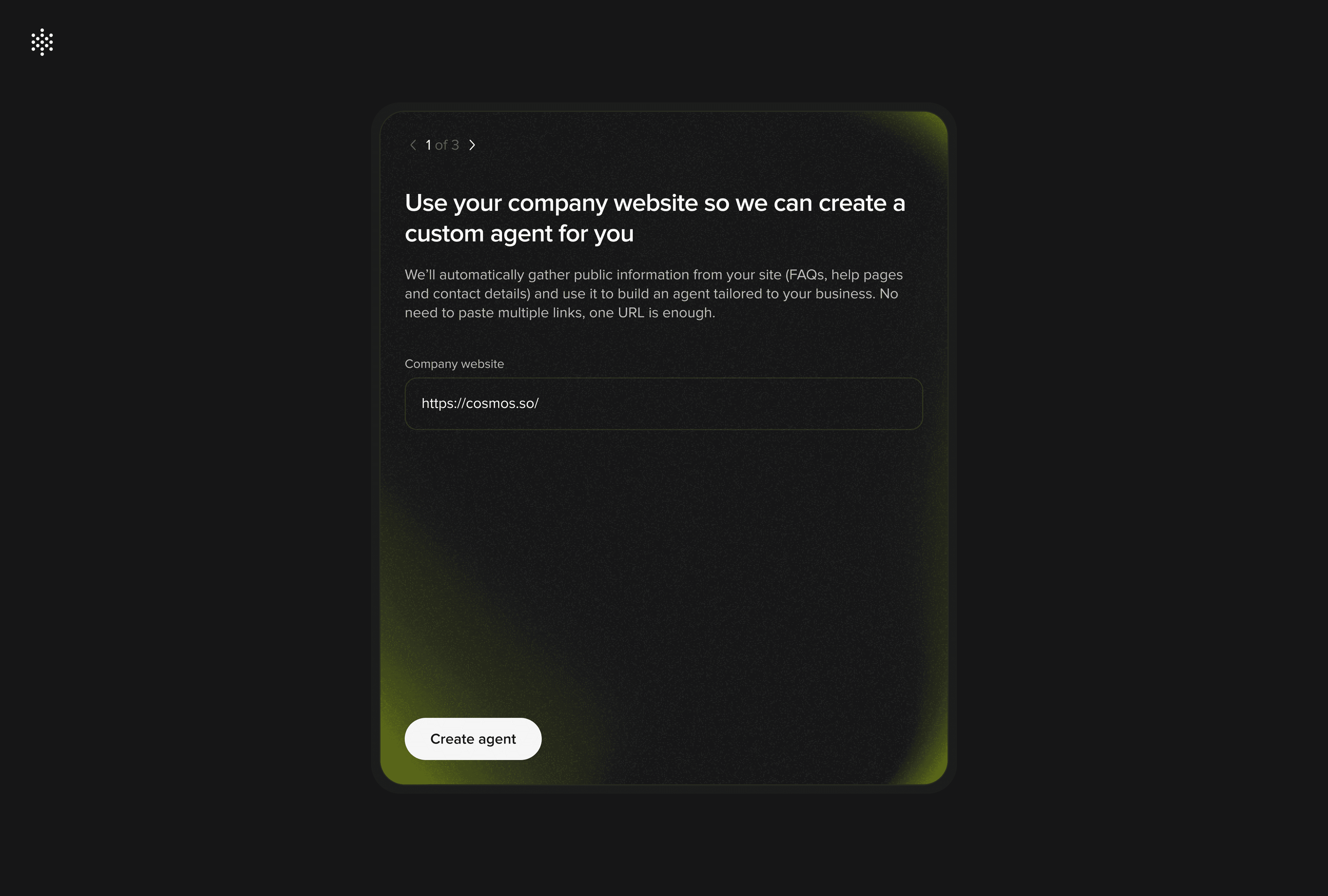
Step 1 of 3: paste a website. Post-launch redesign
Make the wait
worth it
Building the agent took minutes. Instead of a loading screen, people picked their agent’s voice and answered a few quick questions, with a status line showing how long was left.
A colleague argued we were overdoing voice because it’s our domain, and that internal testers were the most biased audience we could find. Fair point, so I treated the voice page as a hypothesis and tested it. Interviews showed people didn’t understand what custom voices were for or how to make one, so we cut them to keep things simple and the quality reliable. In the end only 3% dropped off after the voice page, against 15% at the website step, even though that’s where the wait was longest.


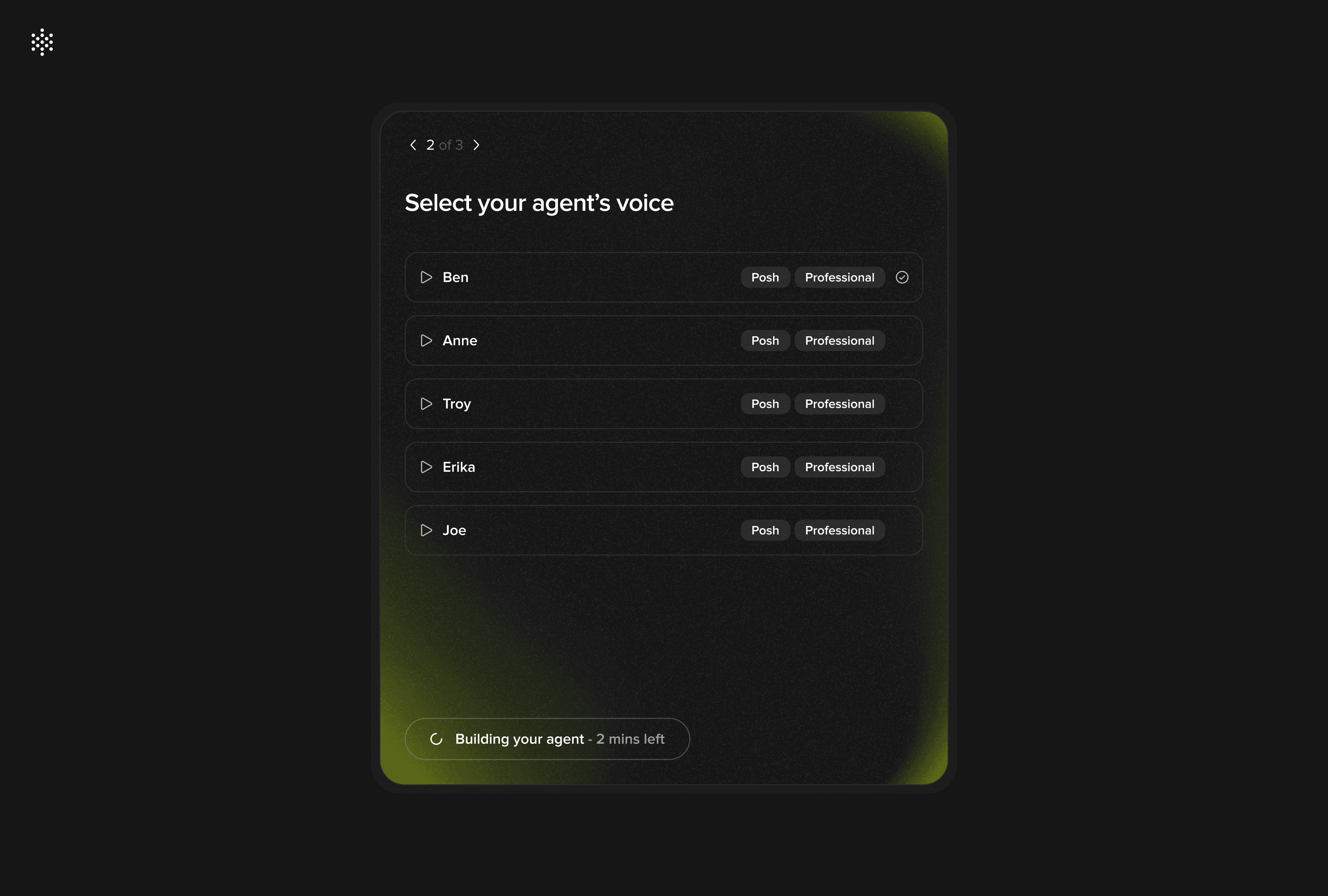
Step 2 of 3: pick a voice while the agent builds. Post-launch redesign.
The aha is hearing
your own agent
The wizard ends on a call with an agent that already knows your business. Guided scenarios sit right next to the call, with what to say and which details to give, so nobody faces a blank screen. They started behind a button, but feedback showed people missed them, so I put them on the call screen itself.


Step 3 of 3: a real, unedited test call with an agent built from poly.ai, scenarios on the right. Post-launch redesign. Sound on.
Help where
people need it
After the wizard, people landed in Agent Studio, the full PolyAI platform for building voice agents, so I designed a product tour to walk them through it. It didn’t work: none of 80 people finished it, and 54% closed it on the first step.
So I moved help to where people need it. Each section got a short overview with a video and links to a walkthrough and docs, which we designed but never shipped. What did ship is a resource center that puts every tutorial in one place.


What I got wrong
We moved the wizard inside Agent Studio to match the rest of the platform, and sales lost the scenarios and the screen they used to record demos. I hadn’t realized they relied on it. I owned the mistake: internal users got the old wizard back the same day, and two weeks later scenarios shipped in every test call across Studio.
If I did it again, I’d also give people a way to skip the wizard entirely and just explore the platform.
Before sign-up
From day one I argued the voice experience belonged on the website, before sign-up, because people sign up once they’re hooked. In the end it stayed behind sign-up and never made it onto the website. The same idea shaped the share link: build an agent, send the link to your boss, and they can call it without an account.


Impact
• First product-qualified lead became a sales lead within two weeks
• First product-qualified lead within two weeks of launch
• A hotel group partner signed up from our website, tried the wizard one evening and asked for an intro
• Sales demo prep went from 3–4 hours to under 30 minutes
• Only 3% dropped off during the wait, against 15% at the website step
• 83% of people who published a change called their agent straight away